
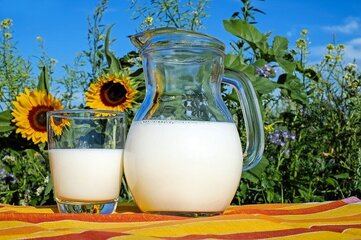
Milk has gotten a bad rap in natural health circles over the past few years. Today I'd like to try and clear up some of the confusion.
Let me first say that I'm not a huge milk drinker, and really never have been. Even growing up on a farm, with the freshest, healthiest milk possible, it just never appealed to me that much - although I do love other milk products like yogurt, cheese, butter, and ice cream (and who doesn't?) :-) And I do cook with milk somewhat often, but I probably don't use that much compared to most Americans.
When I think about milk in general as a food, it has always seemed kind of odd and unnatural to me that we drink the milk of another species (we are the only creature who does this), even as adults - all other species only drink milk as babies - and of course only their own! But perhaps it shouldn't seem so strange. After all, humans have been consuming milk for thousands of years. While in this country we think of milk as coming from cows or maybe goats, cultures the world over have regularly consumed sheep's milk, yak's milk, horse's milk, and even camel's milk. In some societies milk has been a major source of fat and protein, and a fairly important part of the diet for survival. The consumption of milk by humans goes back at least 9,000 years, and it's not going anywhere anytime soon.
But recent critics of milk point to a number of supposedly milk-related health problems. They say that milk increases acidity in the body, is difficult to digest and leads to allergies, and (as my observation above) that it is an unnatural substance for the human body to consume. While all of these concerns may certainly have some truth to them, I take issue with the fact that these critics lump all milk together. As with most foodstuffs, how it is processed makes quite a difference, and as is certainly the case with milk, the wrong kind of processing can not only diminish, but even completely destroy any nutritional properties the food originally contained.
Let me first say that I'm not a huge milk drinker, and really never have been. Even growing up on a farm, with the freshest, healthiest milk possible, it just never appealed to me that much - although I do love other milk products like yogurt, cheese, butter, and ice cream (and who doesn't?) :-) And I do cook with milk somewhat often, but I probably don't use that much compared to most Americans.
When I think about milk in general as a food, it has always seemed kind of odd and unnatural to me that we drink the milk of another species (we are the only creature who does this), even as adults - all other species only drink milk as babies - and of course only their own! But perhaps it shouldn't seem so strange. After all, humans have been consuming milk for thousands of years. While in this country we think of milk as coming from cows or maybe goats, cultures the world over have regularly consumed sheep's milk, yak's milk, horse's milk, and even camel's milk. In some societies milk has been a major source of fat and protein, and a fairly important part of the diet for survival. The consumption of milk by humans goes back at least 9,000 years, and it's not going anywhere anytime soon.
But recent critics of milk point to a number of supposedly milk-related health problems. They say that milk increases acidity in the body, is difficult to digest and leads to allergies, and (as my observation above) that it is an unnatural substance for the human body to consume. While all of these concerns may certainly have some truth to them, I take issue with the fact that these critics lump all milk together. As with most foodstuffs, how it is processed makes quite a difference, and as is certainly the case with milk, the wrong kind of processing can not only diminish, but even completely destroy any nutritional properties the food originally contained.


 RSS Feed